cfa
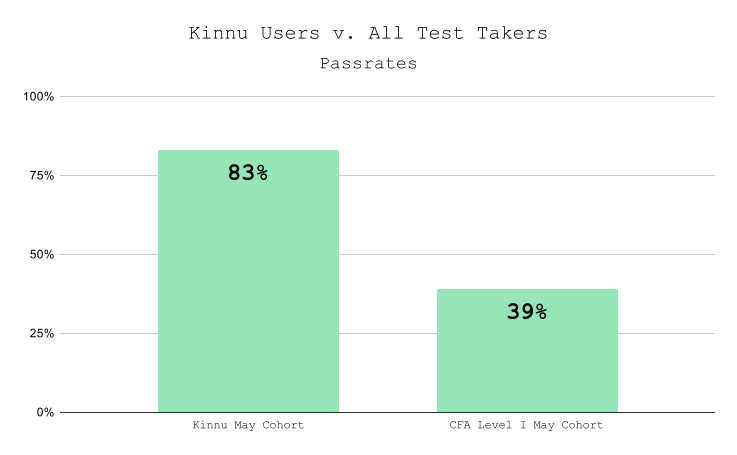
Only 39% of CFA Candidates Passed the May Level I Exam, 83% of Kinnu Users Did
CFA Institute's official May Level I pass rate was 39%. Here's how Kinnu users compared.
We crunched the data on tens of thousands of real answers to find the trickiest question from each topic area.
We've been busy crunching the data on our Level I questions, and we think you'll want to see what we've found.
We have over 3,000 MCQs on our CFA® Level I platform, over 1,000 free trial starts, and each active user, on average, answers 100+ questions. That adds up to a massive dataset of real-world answers, which means we know exactly which questions Level I candidates are struggling with the most, and we've decided to share them with you!
So, without further ado, here are the single trickiest questions from each topic, according to difficulty. Can you get them right first try?
Case Study: A company with a 5-year bank loan (3 years remaining) breaches a financial covenant as of 31 December. On 15 January (after year-end but before the financial statements are authorized/issued), the lender provides a waiver that cures the violation and waives the covenant for at least the next 12 months.
How should the loan be classified on 31 December under IFRS and under US GAAP?
A. Current under IFRS; non-current under US GAAP.
✅ Correct — IFRS requires classification based on the borrower's right at the reporting date; because the waiver was obtained after year-end, the borrower did not have the right to defer settlement for 12 months at 31 December, so it is current. US GAAP permits non-current classification if a waiver is obtained before the financial statements are issued and it extends at least 12 months from the balance sheet date.
B. Non-current under both frameworks, given the lender's waiver before financial statements were authorized/issued.
❌ Incorrect — Under IFRS, a post–reporting date waiver does not change classification at the balance sheet date; the liability is current because the right to defer did not exist at 31 December.
C. Current under both frameworks, because the covenant was breached at the reporting date and the waiver occurred after year-end.
❌ Incorrect — Under US GAAP, a timely waiver that extends beyond one year allows non-current classification despite the year-end breach.
Offering which embedded provision would most likely allow an issuer to set the lowest coupon rate at issuance, all else equal?
A. Investor put option
❌ Incorrect — While this feature also lowers the coupon rate compared to a standard straight bond (because it favors the investor), the upside is capped at par value. The equity conversion option has unlimited upside potential.
B. Equity conversion option
✅ Correct — Granting investors the right to convert into equity (convertible bond) is highly valuable to them, so issuers can offer the lowest coupon relative to otherwise similar bonds.
C. Issuer call option
❌ Incorrect — A call option benefits the issuer; investors demand additional yield to compensate for call risk and reinvestment risk, leading to a higher coupon.
Case Study: Haven Ridge Balanced Fund manages a 60/40 portfolio benchmarked to a public index, using small, systematic tilts based on value and quality signals to outperform by 50 to 100 basis points per year. The team targets annual tracking error near 0.75% and does not carry positions intended to offset any operating or transactional exposures.
Additional details: AUM $6.4 billion; turnover 40%; management fee 0.35%.
Which label is least likely to describe Haven Ridge's objective?
A. Benchmark-oriented investor
❌ Incorrect — The portfolio is benchmarked with controlled tracking error, which aligns with an investor mandate aiming for market-like returns with small active bets.
B. Information-motivated trader
❌ Incorrect — The use of systematic signals to seek modest outperformance is a form of information-driven active risk; this label is more fitting than a hedging label.
C. Risk-management hedger
✅ Correct — The fund is not offsetting a specific business risk or stabilizing an existing exposure. It manages a benchmark-relative portfolio with modest active tilts, so a hedging label least fits the stated objective.
Which statement most accurately describes a tax-related advantage often associated with REITs?
A. Income is generally taxed once at the investor level when distributed
✅ Correct — REITs typically avoid corporate-level income taxation by distributing most taxable income, so the income is generally taxed once at the investor level rather than being taxed at both corporate and shareholder levels.
B. Income is generally taxed once at the REIT level before distribution
❌ Incorrect — The common advantage is reduced or eliminated entity-level tax when distribution requirements are met; taxation typically occurs at the investor level on the distributions received.
C. Income is generally taxed at preferential rates at the investor level
❌ Incorrect — A common disadvantage is that many REIT distributions are taxed as ordinary income, so preferential dividend rates are not the defining tax advantage of REITs.
Case Study: Domestic inflation is 6%, foreign inflation is 2%, and the nominal exchange rate remains unchanged.
What happens to the domestic currency in the short run?
A. Real depreciation.
❌ Incorrect — Higher domestic inflation without nominal depreciation makes domestic goods relatively pricier, not cheaper.
B. Real appreciation.
✅ Correct — With higher domestic inflation and no nominal change, domestic goods become relatively more expensive, implying a real appreciation and reduced external competitiveness.
C. No change in the real exchange rate.
❌ Incorrect — A relative inflation differential changes the real exchange rate even if the nominal rate is unchanged.
In a no-tax setting with riskless debt, as the firm's debt-to-equity ratio increases, which combination is most accurate?
A. The cost of equity is unchanged, the cost of debt and WACC both decline.
❌ Incorrect — The cost of equity rises with leverage in Proposition II; with no taxes, WACC does not fall.
B. The cost of equity rises, the cost of debt rises, and WACC rises.
❌ Incorrect — With riskless debt in the no-tax world, the cost of debt is assumed flat and WACC remains constant despite higher debt-to-equity.
C. The cost of equity rises, the cost of debt is unchanged, and WACC remains unchanged.
✅ Correct — Under M&M without taxes, the cost of equity rises with D/E per Proposition II, the cost of debt is assumed flat (riskless debt), and WACC stays equal to the cost of equity of an unlevered firm for all leverage.
Case Study: To estimate a 95% confidence interval for a mean, an analyst computes 10,000 bootstrap replications.
Which effect is most likely from increasing the number of bootstrap replications from 1,000 to 10,000?
A. The interval becomes more numerically stable due to reduced Monte Carlo error.
✅ Correct — More replications reduce simulation noise in percentile estimates but do not change the underlying sampling properties of the estimator or fix small-sample bias.
B. The bootstrap eliminates small-sample bias in the estimator.
❌ Incorrect — Increasing replications does not remove estimator bias or coverage issues driven by a small sample size.
C. The true variance of the estimator decreases because more samples are used.
❌ Incorrect — Replications do not change the true sampling variance; they only improve the precision of its estimate.
Case Study: To reward strong returns, a client offers Emily Cruz, CFA, a $10,000 bonus at year-end in addition to the firm's fees. Cruz tells her team lead verbally.
Which option most accurately identifies any violation?
A. Cruz did not violate the Code and Standards because relevant stakeholders are well aware of the additional compensation.
❌ Incorrect — Standard IV(B) explicitly requires written consent from all parties involved before accepting additional compensation. Mere verbal notification or general "awareness" is insufficient; there must be a formal record of the permission.
B. Cruz violated the Code and Standards by agreeing to receive additional compensation.
✅ Correct — Standard IV(B) Additional Compensation Arrangements requires written consent from the employer and any other parties involved before accepting compensation that could create a conflict. Recommended procedures include obtaining prior written approval and keeping records of any such arrangements.
C. Cruz violated the Code and Standards by failing to disclose the arrangement to other clients.
❌ Incorrect — Disclosure to other clients is not required; the issue is written consent from the employer and involved parties.
Which statement about the effect of adding risky securities to a portfolio on total risk is most accurate in the context of the portfolio approach?
A. As additional risky securities are added, total risk continues to decline roughly in proportion to the number of holdings.
❌ Incorrect — Risk does not fall linearly with the number of securities; beyond a modest number of holdings, the marginal reduction in total variance becomes very small.
B. As additional risky securities are added, total risk eventually rises once the portfolio holds more securities than the market index.
❌ Incorrect — Holding more securities than the index does not inherently increase variance; portfolio risk is driven by factor exposures and correlations, not by exceeding some threshold count.
C. As additional positively correlated securities are added, total risk declines at a decreasing rate and approaches a lower bound.
✅ Correct — Diversification rapidly reduces unsystematic risk at first, but incremental benefits shrink as more correlated securities are added, causing portfolio risk to converge toward systematic risk.
Case Study: An analyst reviews three contracts: (1) a standardized exchange-traded futures on crude oil; (2) a European call option on a stock; (3) a credit default swap on a corporate bond.
Which classification is most accurate for instruments (1), (2), and (3), respectively?
A. Forward commitment; Contingent claim; Contingent claim.
✅ Correct — Futures are forward commitments with mutual obligations; options and CDS payoffs are contingent on defined conditions.
B. Contingent claim; Contingent claim; Forward commitment.
❌ Incorrect — A futures contract is not a contingent claim, and a CDS is not a forward commitment.
C. Forward commitment; Forward commitment; Forward commitment.
❌ Incorrect — Options and CDS are contingent claims because their payoffs are triggered by conditions, not unconditional obligations.
cfa
CFA Institute's official May Level I pass rate was 39%. Here's how Kinnu users compared.

cfa
Kinnu answers the most frequently asked CFA Level I questions from r/CFA.

cfa
What you can earn, after you learn.

company
The octopus is finally out of the bag

research
At Kinnu we spent ten months researching learning interventions rooted in cognitive science. Here's how we did it, and how it's shaped the app.

research
The Generative AI Revolution is here, and like the French Revolution it will shake up the old order.

research
Follow our formula for creating beautiful image sets with a consistent style. Ideal for content creators, marketers, web designers and more. This article assumes you have a basic familiarity with how to use Midjourney.

research
Can an AI create any learning pathway you can think of in under 5 seconds? We are about to find out. A deepdive into how Kinnu produces its learning materials.