cfa
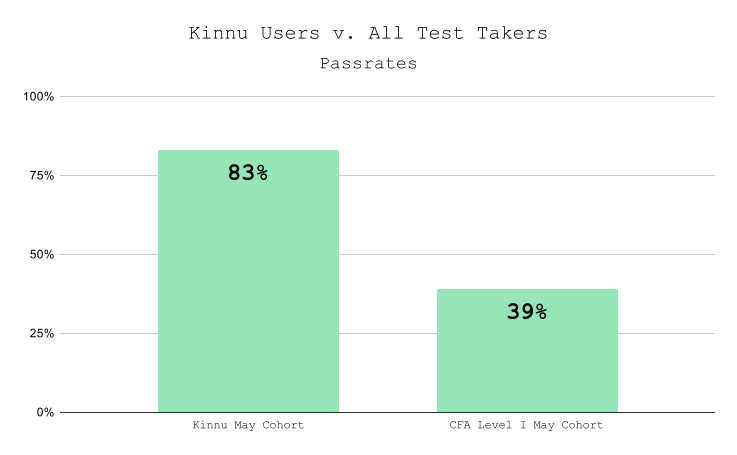
Only 39% of CFA Candidates Passed the May Level I Exam, 83% of Kinnu Users Did
CFA Institute's official May Level I pass rate was 39%. Here's how Kinnu users compared.
What you can earn, after you learn.
Passing Level I alone is not going to get you a job — but it will open doors that may have once been closed to you.
Studying for Level I demonstrates a commitment to finance that others applying to entry level roles may not have. Think about it: if you had two candidates with the same background, but one had passed CFA Level I, which would you pick?
Level I is especially crucial for career switchers. You need to speak the language that your peers are already fluent in.
The CFA Institute suggests that after passing Level I you can start looking at entry-level, junior, and internship roles across:
In India, 55% of companies who hire CFA candidates are global multinational corporations, which is a bit surprising (CFA Institute, 2023). If you want to expand your horizons even beyond the pure finance world, starting the CFA program is a great place to start.
At this point you're probably thinking: passing Level I may help me get my foot in the door, switch to a career in finance, or get into a global company with equally global opportunities, but…
Full-time junior roles in these areas garner salaries of up to $200,000.
Even if you are already working in finance, you will likely see a 14% pay bump for passing Level I (Kaplan Schweser CFA Survey, 2025).
| Sector | Job Title | Primary Responsibility | Total Comp. Est. (incl. Bonus) |
|---|---|---|---|
| Equity Research | Junior Equity Research Associate | Analyzing financial statements and industry trends, leading to "Buy/Hold/Sell" recommendations on stocks. | $110,000 – $130,000+ |
| Fixed Income | Fixed Income Analyst | Evaluating creditworthiness and interest rate risks to value bonds, notes, and other debt instruments. | $100,000 – $125,000 |
| Asset Management | Junior Asset Management Analyst | Monitoring portfolio performance and conducting due diligence to support long-term investment strategies for institutional clients. | $95,000 – $110,000 |
| Wealth Management | Wealth Management Analyst | Developing personalized financial plans, tax strategies, and investment allocations for high-net-worth individuals. | $85,000 – $105,000 |
| FP&A | Junior Financial Analyst | Managing internal budgets, forecasting revenue, and performing variance analysis to guide corporate decision-making. | $70,000 – $85,000 |
| Investment Banking | Investment Banking Analyst | Executing complex financial modeling and "pitch books" for mergers, acquisitions (M&A), and capital raising. | $160,000 – $200,000+ |
According to the CFA Institute (2024), Charterholders are more likely to be in portfolio management than any other vertical:
A majority of charterholders agree that their CFA charter has helped them move into a leadership position — a supermajority of senior executives do (CFA Institute, 2024).
Thus, after successfully gaining your charter you can expect to be in a leadership position, most likely in portfolio management or research. But the question remains, how much can you actually make?
In India, after receiving their Charter, candidates have usually 3x'd their Level I earnings (CFA Institute, 2023).
| Career Step | Average Raise |
|---|---|
| Level 1 → Level 2 | ~33% |
| Level 2 → Level 3 | ~33% |
| Level 3 → Charterholder | ~66% |
| Cumulative Raise | 193.6% (nearly 3x) |
Globally, the average total compensation across all job functions for a CFA Charterholder is $267,000 (CFA Institute, 2024).
The highest paid vertical you can get into after gaining your charter is becoming a Chief Investment Officer. One in ten charterholders are CIOs, and they earn an average of $350,000 in the U.S. (CFA Institute, 2024).
| Vertical | Job Title | Primary Responsibility | Average Total Comp (U.S.) |
|---|---|---|---|
| Portfolio Management | Portfolio Manager (PM) | Investment decision-making & fund strategy | $200,000 – $400,000+ |
| Research / Analysis | Senior Buy-Side Analyst | Deep-dive valuation and sector expertise | $220,000 – $310,000 |
| Investment Strategy | Chief Investment Strategist | Macro-economic forecasting & asset allocation | $250,000 – $380,000 |
| Consulting | Institutional Consultant | Advising pension funds and endowments | $190,000 – $260,000 |
| Executive Leadership | Chief Investment Officer (CIO) | Overseeing entire investment organization | $300,000 – $500,000+ |
So whenever you are elbow deep in Derivatives, or you're not sure you'll ever really understand Ethics, remember: it is worth it.
cfa
CFA Institute's official May Level I pass rate was 39%. Here's how Kinnu users compared.

cfa
We crunched the data on tens of thousands of real answers to find the trickiest question from each topic area.

cfa
Kinnu answers the most frequently asked CFA Level I questions from r/CFA.

company
The octopus is finally out of the bag

research
At Kinnu we spent ten months researching learning interventions rooted in cognitive science. Here's how we did it, and how it's shaped the app.

research
The Generative AI Revolution is here, and like the French Revolution it will shake up the old order.

research
Follow our formula for creating beautiful image sets with a consistent style. Ideal for content creators, marketers, web designers and more. This article assumes you have a basic familiarity with how to use Midjourney.

research
Can an AI create any learning pathway you can think of in under 5 seconds? We are about to find out. A deepdive into how Kinnu produces its learning materials.