SAT Practicalities: Registration, Fees, and Calculator Rules
Everything you need to know that isn’t actually on the test.
When is the SAT offered?
The SAT is offered on set national test dates roughly seven times a year in the U.S., with sittings usually landing in August, October, November, December, March, May, and June. Those exact dates shift a little each year, so it is worth checking College Board’s official calendar.
When are the registration deadlines?
Registration deadlines follow a predictable rhythm. The regular deadline usually falls about a month before the test date, after which a short late-registration window (for an extra $38 fee) stays open until roughly a week or two out. Miss that, and you’re waiting for the next sitting. The lesson is simple: register early. The popular spring dates fill up, and the testing centers closest to you can run out of seats well before the official deadline.
How much does the SAT cost?
At the time of writing, the base SAT registration fee is $68. If you are an international student, you have to pay an additional $43 fee. As mentioned above, you can incur other fees like a late registration fee, cancellation fee, and test center change fee. Full table below:
| Service / Fee Type | Fee |
|---|---|
| Standard SAT Registration | $68 |
| International Fee | $43 (in addition to registration) |
| Test Center Fee (select locations only) | $24 |
| Change Test Center | $34 |
| Cancel Fee (by change deadline) | $34 |
| Late Cancel Fee (after change deadline) | $44 |
| Late Registration | $38 |
How do I sign up?
Signing up happens entirely online. You create a free College Board account, choose your date and a nearby test center, and pay the registration fee. If that fee is a barrier, don’t just skip the test: College Board offers fee waivers for eligible students, and your school counselor can walk you through getting one. Those waivers tend to unlock other perks too, like free score reports sent to colleges.
How long is the SAT?
On test day, the digital SAT itself runs 2 hours and 14 minutes, not counting a 10-minute break. That time is split between two sections, Reading & Writing (64 minutes) and Math (70 minutes). If you’ve heard horror stories about the old paper SAT stretching past three hours, breathe easy: the digital version is much shorter.
What formulas are provided on the SAT Math section? What is the Reference Sheet?
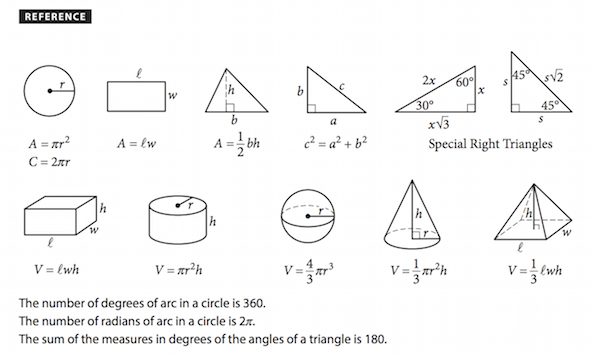
You don’t have to memorize a wall of formulas for the Math section. Every student gets an on-screen reference sheet with a dozen of the most common geometry formulas on it: areas and circumferences, the Pythagorean theorem, the side ratios of special right triangles, the volumes of basic solids, and reminders like the 360 degrees in a circle (see example Reference Sheet below). It’s genuinely useful, but leaning on it too hard bleeds time. The strongest test-takers know these cold and only glance at the sheet to confirm, instead of hunting for a formula in the middle of a problem.
What are the rules regarding calculator usage?
You can use one on the entire Math section — there aren’t any “no-calculator” questions anymore. In fact a Desmos graphing calculator is built directly into the Bluebook testing app, so you don’t need to own an expensive graphing calculator to compete. You’re welcome to bring your own approved calculator as a backup, but the embedded Desmos is powerful enough that learning to drive it well (graphing equations, solving systems, finding intersections, making tables, in a couple of clicks) is one of the highest-leverage things you can practice before test day.
Start your 7-day free trial now
No credit card required
Get instant access
Start learning now
- Full access to all Questions
- Full access to all Study Notes
- Full access to all Flashcards
- Full access to Practice Exams
- Lara AI tutor
- Prep Score & performance analysis
- Desktop & Mobile app