Practice Questions
Practice smarter
Highest quality, expert-reviewed, always up-to-date, with Lara AI by your side.
Kinnu - SAT Exam Prep
The all-in-one platform for your dream SAT score
Then just $19/month, cancel anytime.
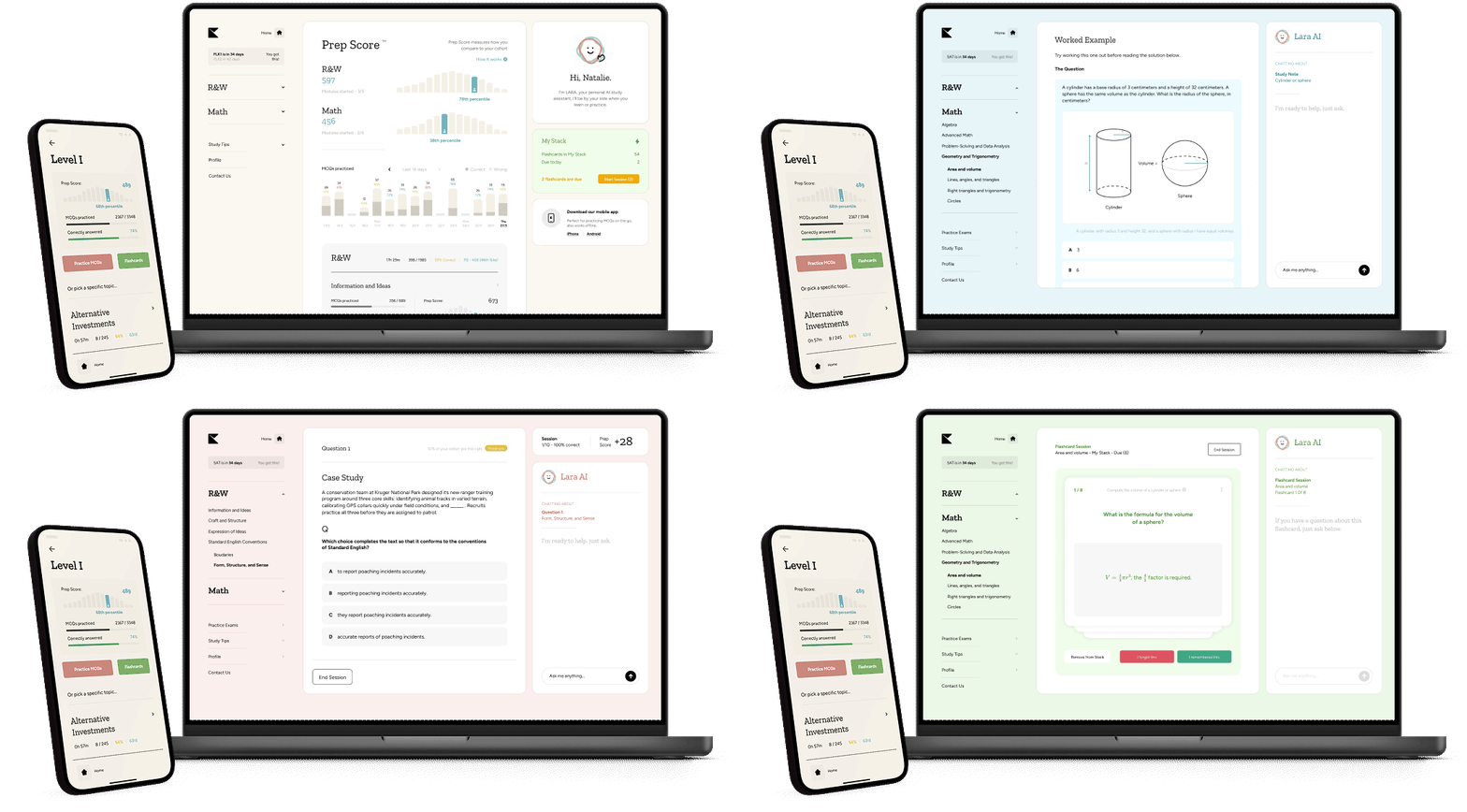
All in one place. Questions, Practice Tests, Flashcards, Notes.
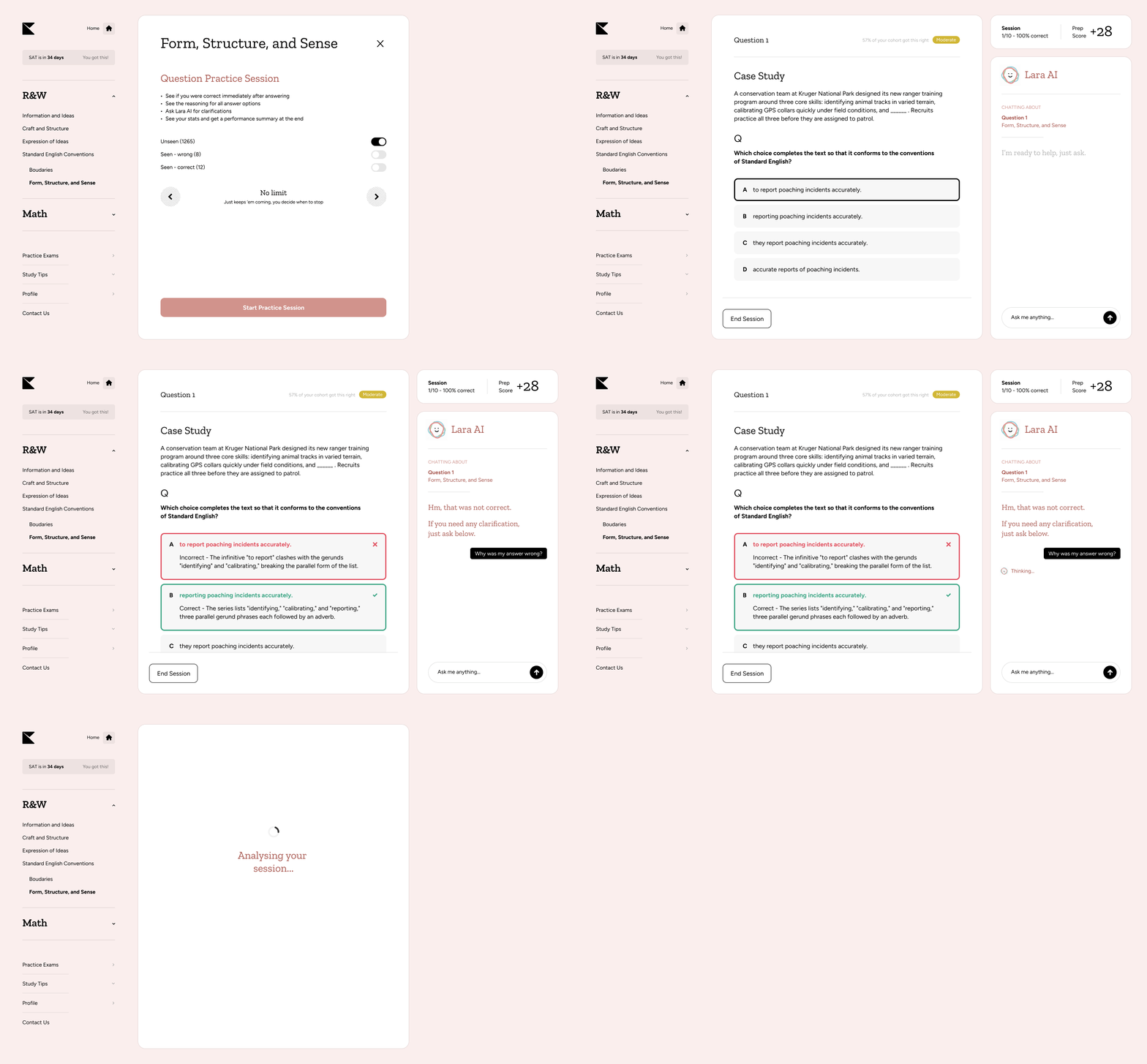
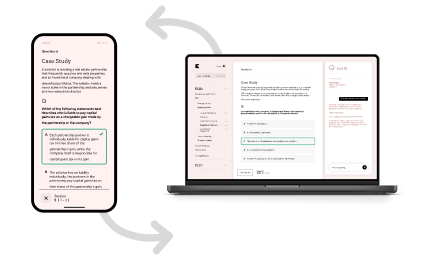
Ask Lara AI for instant explanations, right when you need it

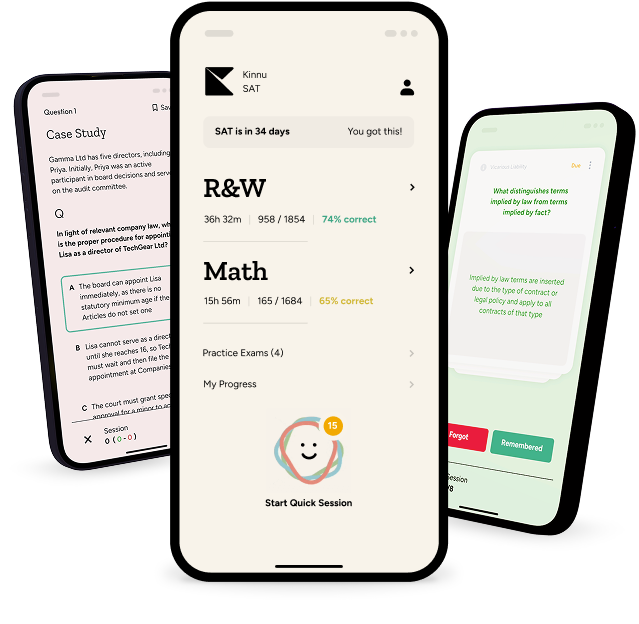
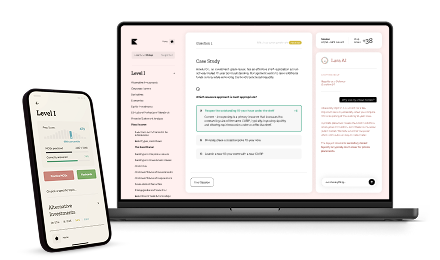
Study anywhere, anytime — on your phone or laptop

Get instant access
Start my free 7-day trial

Over
1,500
Questions

Over
80
Study Notes

Over
500
Flashcards

And
4
Practice Tests

Questions, Practice Tests, Flashcards, Notes.
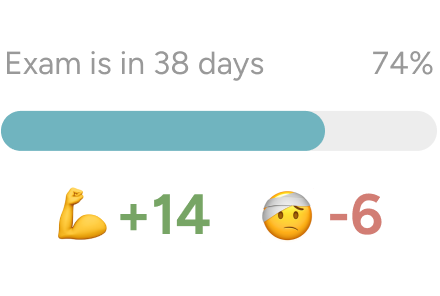
Celebrate your progress and have fun

Exam prep that fits into your busy life
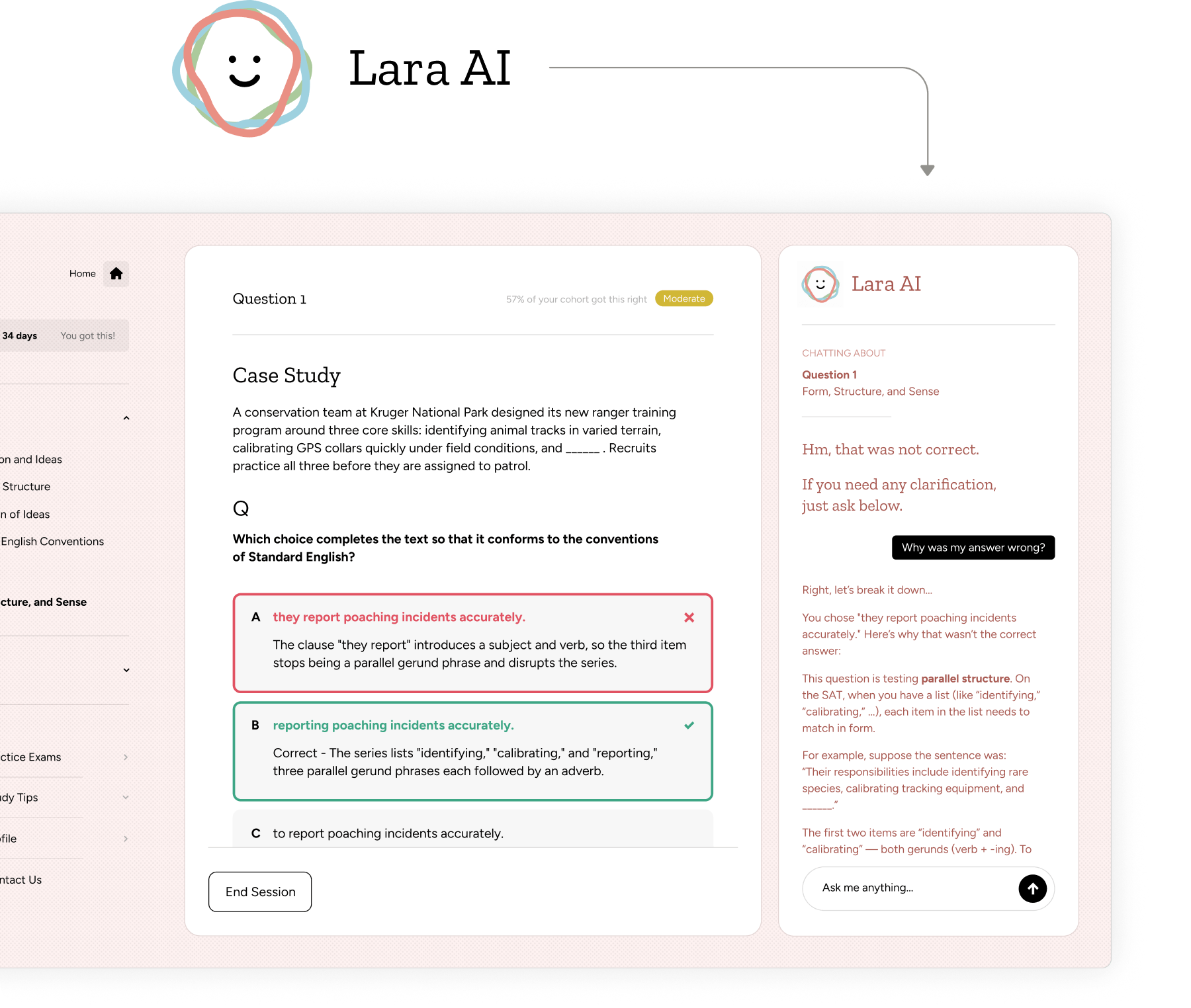
Powered by a bespoke SAT-specific AI model, directly trained on key material, formulas and frameworks, as well as expert notes from top-quintile exam scorers.
 SAT-specific AI model, trained on key material, formulas and frameworks, as well as expert notes from top-quintile exam scorersNo copy/pasting, just ask - knows exactly what you're currently asking about and automatically loads all relevant contextAnswers are designed to be specific to the SAT context, with fine-tuned level of detail and focusIntelligent prompt analysis to help guide each response
| ChatGPT | Lara AI |
|---|---|
 Prone to hallucination, especially on highly technical content such as the SAT Prone to hallucination, especially on highly technical content such as the SAT | SAT-specific AI model, trained on key material, formulas and frameworks, as well as expert notes from top-quintile exam scorers |
| Constant copy/pasting of content - has no awareness of what you're currently learning and your progress | No copy/pasting, just ask - knows exactly what you're currently asking about and automatically loads all relevant context |
| Broad, general answers to questions | Answers are designed to be specific to the SAT context, with fine-tuned level of detail and focus |
| Generic prompting only | Intelligent prompt analysis to help guide each response |
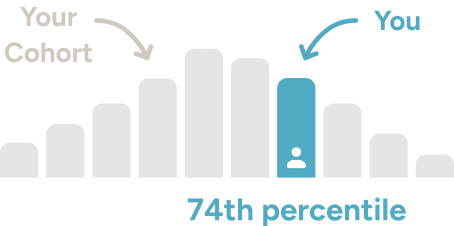
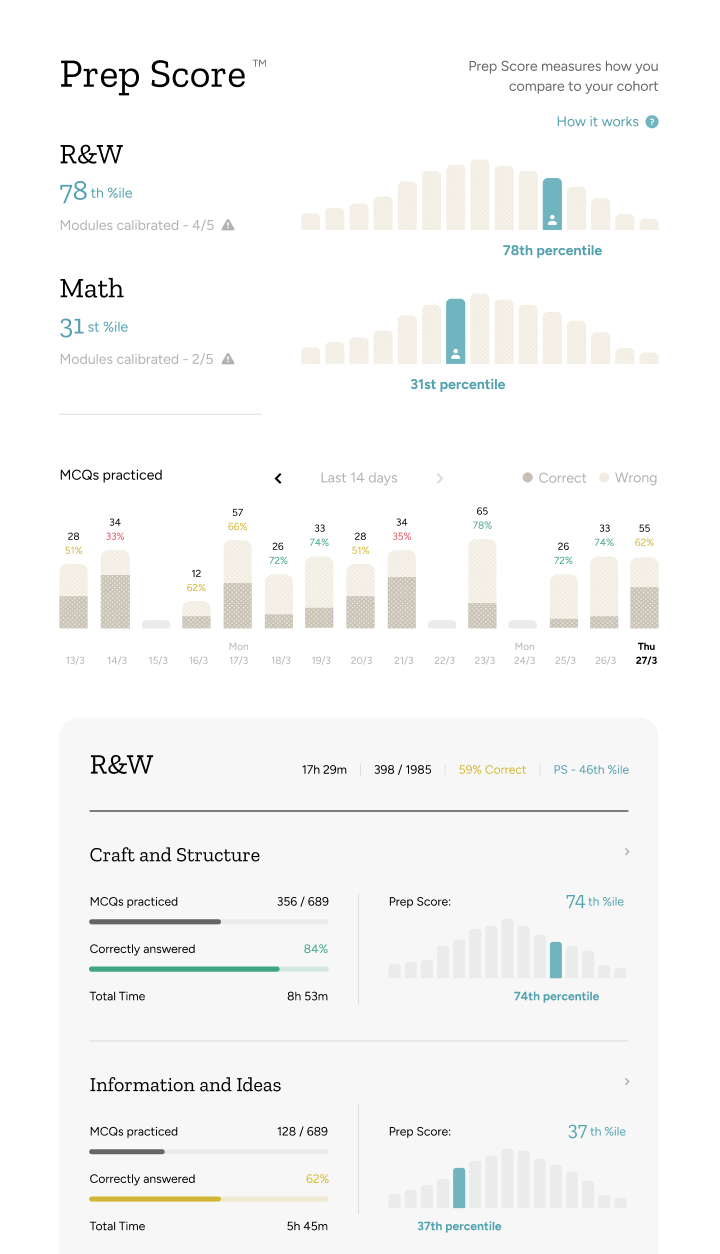
See exactly how ready you are — compared to your actual cohort
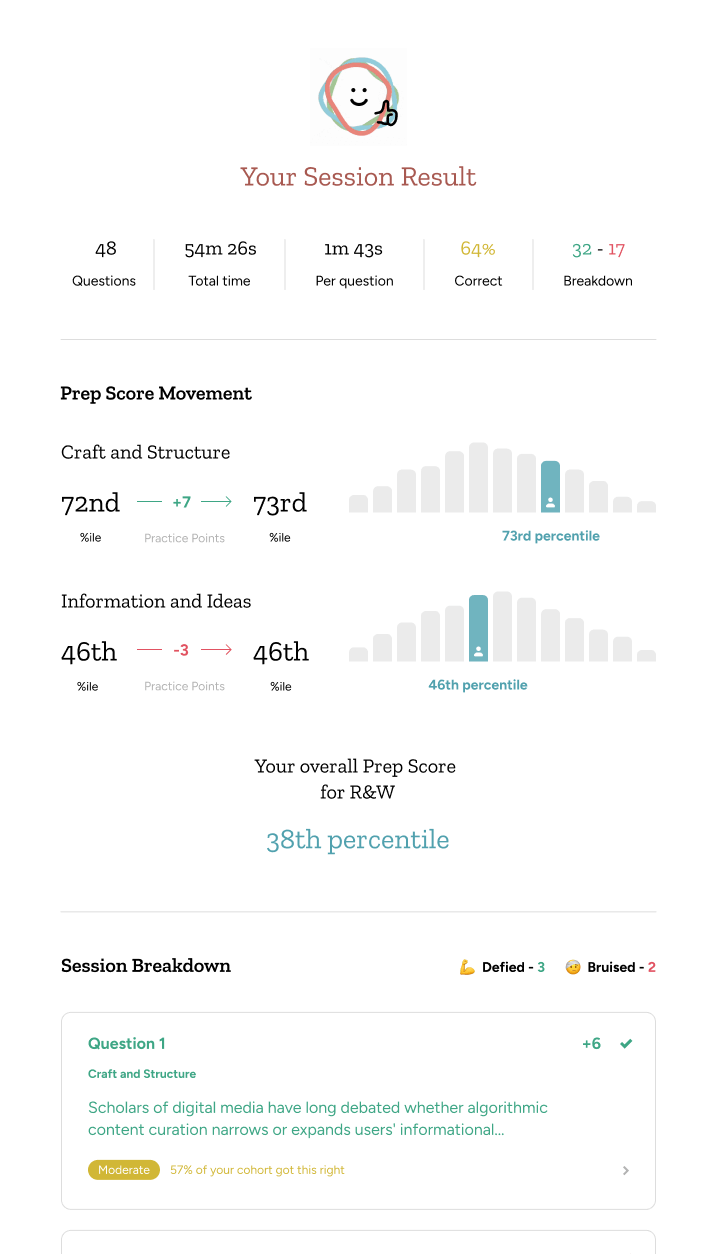
Our Prep Score can measure how well you are doing in your questions compared to your cohort.
Unlike % correct, Prep Score also factors in the difficulty of each question you do — making it a far more accurate reflection of your exam-preparedness.
Everything you need.
In one place.
Highest quality, expert-reviewed, always up-to-date, with Lara AI by your side.
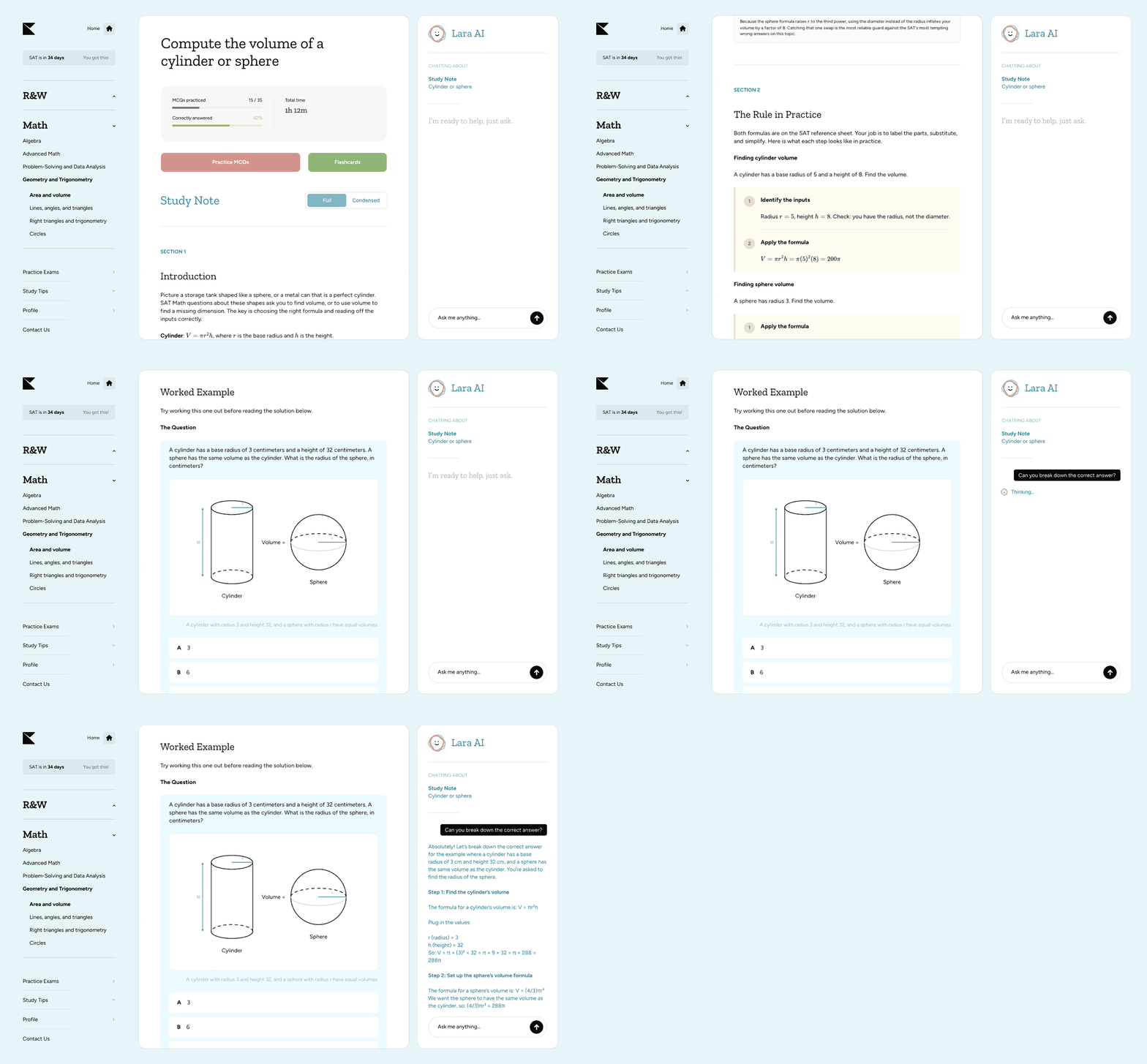
Concise, interactive study notes for every module in the SAT syllabus.
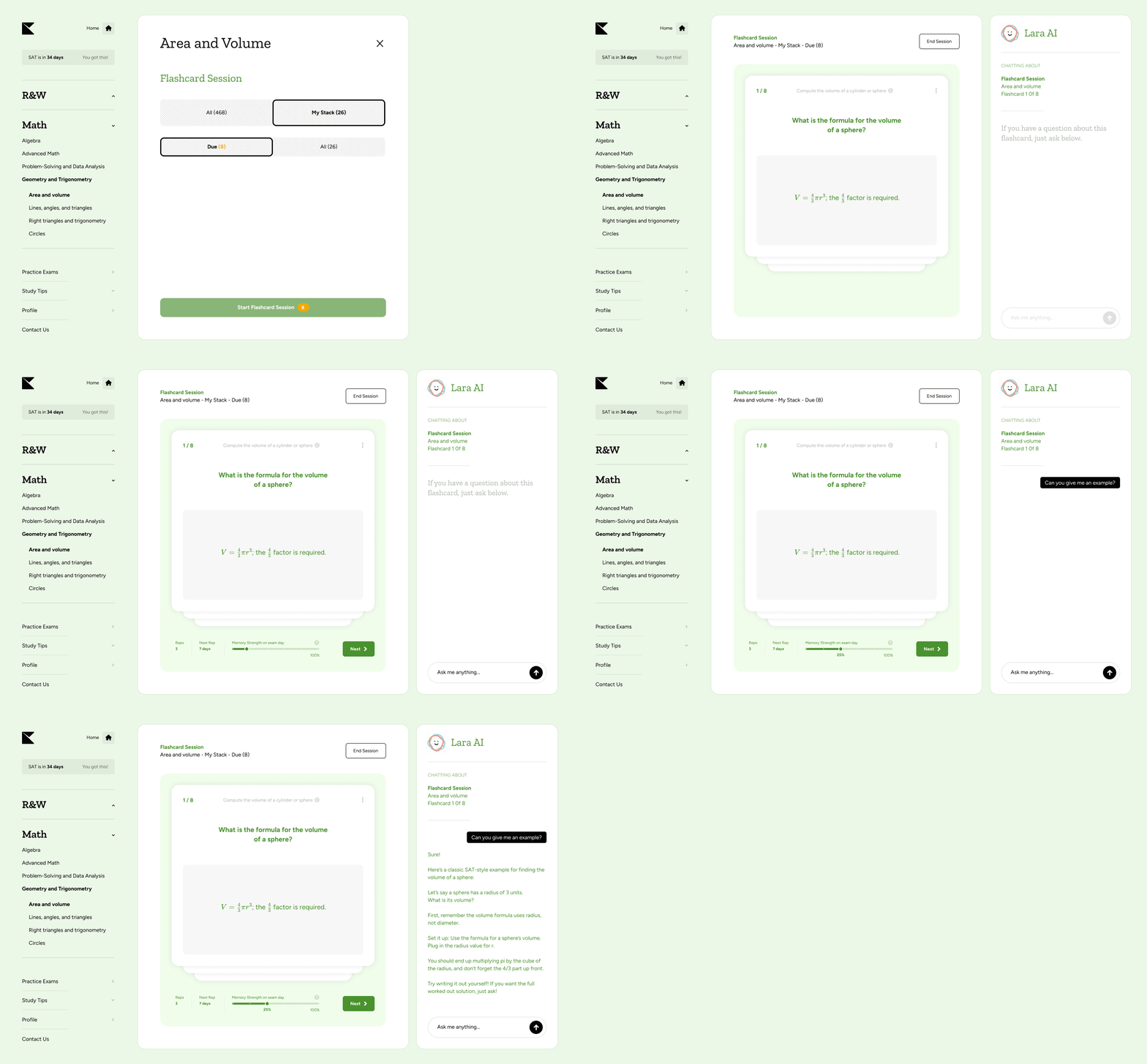
Build your own stack of pre-written flashcards.
Our Spaced Repetition algorithms automatically calculate the perfect frequency of repetition.
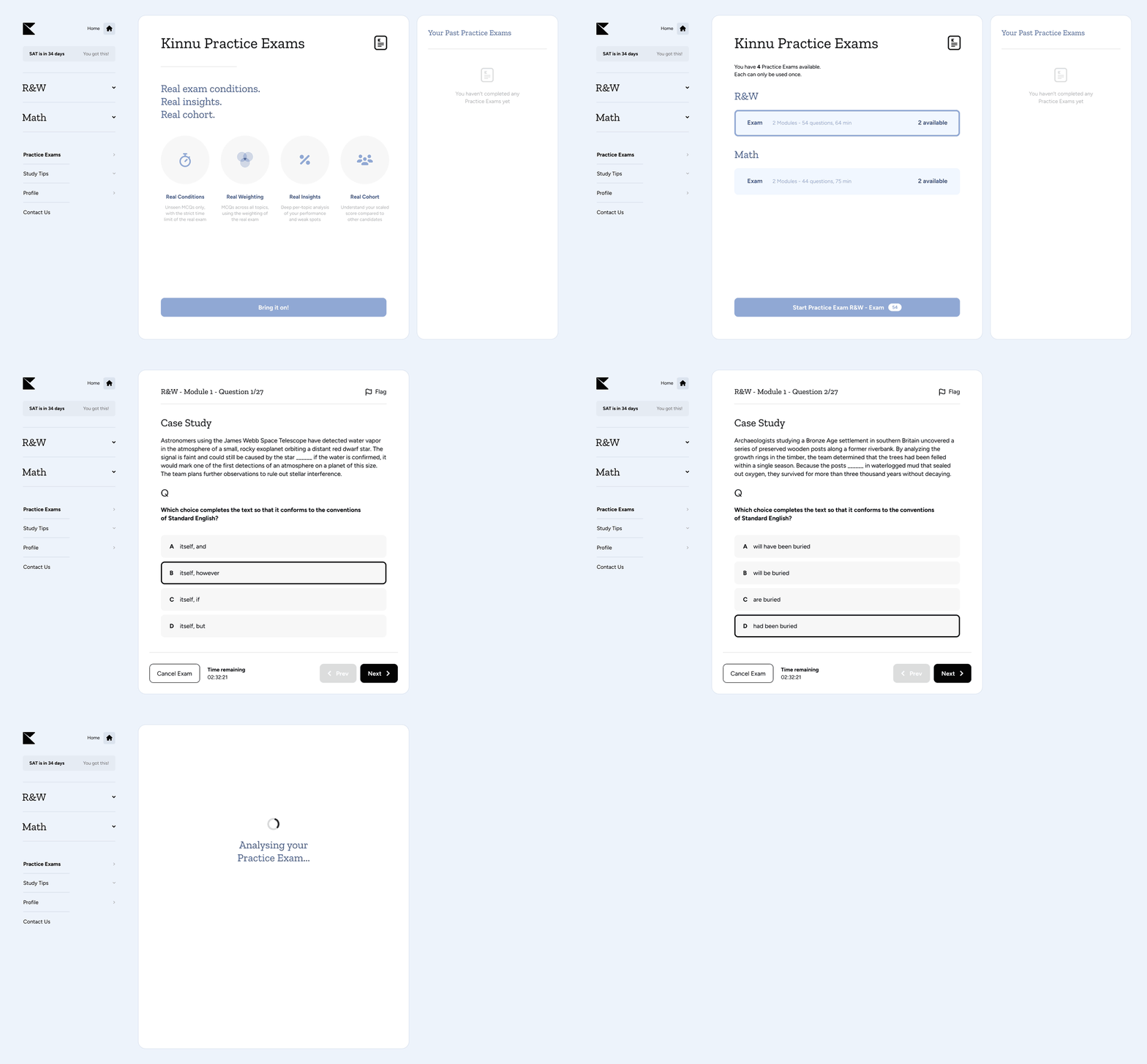
Test your knowledge in strict exam conditions, and see your scaled score compared to your real cohort.
We are developers, scientists, writers, and (above all) learning nerds. We ran experiments with 10,000 people to work out the best way to learn. We built an app with 1 million learners and 6,000 five-star reviews.
We've now turned our attention to the SAT, meticulously interviewing SAT students and tutors to find out exactly what they need. We built an all-in-one learning platform, approved by top-quintile scorers.
We're not another generic AI question bank. We're not an overpriced textbook crammed into a broken app. We're definitely not in the business of leaving your SAT score to chance.

FAQ
The SAT rewards familiarity as much as raw ability. Recognizing question patterns, knowing where the traps are, and moving fast without second-guessing yourself… that only comes from repetition. The best place to get those reps in is Kinnu.
Kinnu breaks the SAT down by its actual test structure and drills you at the individual skill level (e.g. Interpret the solution of a linear system in context), so you know exactly where you're lacking instead of vaguely "studying math."
The habit that separates steep learning curves from flat ones is reviewing your mistakes properly, not just noting the right answer, but working out why you missed it: a content gap, a careless misread, a timing crunch, or a trap. Tracking progress over time is what turns that review into a targeted study plan instead of guesswork. Kinnu gives you insights on your weak spots right down to the skill level.
Start with a full diagnostic test under real conditions on Bluebook to establish your baseline score and see where your points are leaking out by section and skill. From there, track accuracy by category on Kinnu so your practice time goes toward your actual weak spots, not the topics you've already mastered.
Use AI as a personalized, on-demand tutor to diagnose why you got a question wrong. Feed it problems you missed and ask it to break down the underlying concept, generate similar practice questions, or explain a faster shortcut (like a Desmos math trick). Our very own LARA AI does this automatically, it knows exactly what you're looking at and what you're struggling with. No need to copy-paste or screenshot into a new tab.
While there is no magic number, finishing Kinnu's 1500+ question bank is a good goal to keep in mind. Consistency is key, and having a target that you are working towards, one that forces you to practice regularly over two or three months, will build the muscle memory and confidence you need to succeed on test day.
While we did see many universities and colleges go test-optional during COVID, this trend is reversing. LLMs have made writing a solid (but not necessarily exceptional) college essay trivial. GPAs are often inflated. The SAT is once again becoming a cornerstone of college admissions.
Take the UCs. In May 2026, hundreds of professors wrote a letter to the University of California regents to reinstate entrance-exam requirements. Or many Ivies: Yale, Harvard, Brown, and Dartmouth have become test-required in recent years.
As testing becomes critical again, Kinnu makes mastering the SAT simple.
There's no universal cutoff. Aim for the 75th percentile of your target school's admitted class as your target, and treat its 25th percentile as your floor. That being said, most "dream schools" will need at least a 1400 (95%ile).
Keep in mind that a high score won't rescue a weak transcript, it can tip a borderline decision your way, which is why preparing properly with platforms like Kinnu is paramount.
Yes! Practice questions, full practice tests, study notes on every skill, flashcards, an AI Tutor… We've got everything you need. If you bring the motivation and discipline, a 200+ point increase is on the horizon.
Before consistent study, students usually struggle most with:
Kinnu tracks your accuracy down to skills like these individually, so instead of guessing which "subject" is hardest for you, you'll know exactly which ones are actually costing you points.
We break the SAT right down to its building blocks.
While Khan Academy is an excellent resource, it only structures questions at an abstract level. For example, it combines Expression of Ideas and Standard English Conventions into one category, whereas we break them down.
We also organise our questions right down to the skill being tested, whereas Khan Academy keeps it at a theme level (e.g. Words in Context v. Words in Context > Identify the most precise word for a stated meaning).
Kinnu is built around the full learning loop: skill-by-skill diagnostics so you know exactly where you're leaking points, spaced sessions, and LARA AI right inside the question breaking down your mistake in context, no copy-pasting into a separate chatbot.
Also, we have more practice questions!
Kinnu's SAT prep is $19 a month for everything. You get a 7-day free trial with full access, so you can test out the skill tracking and spaced repetition to see if it actually helps before paying a cent.
Yes! The "No-Calculator" section is gone. In fact, you have access to a built-in Desmos graphing calculator for the entire SAT.
The digital SAT has 98 questions total and takes 2 hours and 14 minutes. It's split into two sections, each broken into two modules: Reading and Writing comes first (54 questions, 64 minutes), followed by Math (44 questions, 70 minutes). The second module in each section adapts based on how you did on the first, so a strong Module 1 unlocks harder (and more rewarding) questions in Module 2. Kinnu's mocks mirror this exactly, so no surprises on test day.
Spaced repetition spreads your practice out over time instead of massing it into one sitting, because your brain consolidates skills in the gaps between study sessions, not during them. An hour every couple of days across two or three months beats a ten-hour weekend cram. Kinnu's short, engaging sessions are built around this principle.
You should start practicing questions at the very beginning of your revision, ideally 3–4 months before test day. Early practice surfaces your weak skills while there's still time to fix them, and it gives spaced repetition room to work: spreading sessions out over months lets your brain consolidate each skill in the gaps between practice. Kinnu's sessions are built around spaced repetition and track your skill-level accuracy from day one, so you know exactly where to spend your time.
Start your 7-day free trial now
No credit card required
Get instant access
Start learning now