Weekly update · Issue 3 ·
Is November too early to start listening to Christmas music?
Me thinks not…
They are finally here… Please be seated…
Our brand new SQE1 notes are launching today 🎉
A lot of time, thought and care has gone into rebuilding our notes, with one goal in mind: to make learning and revising for the SQE1 as clear and manageable as possible.
So, what’s changed?
First up, we’ve completely rebuilt our notes.
Every topic has been rewritten to align directly with the SRA’s FLK specifications. We’ve introduced two new pathways and significantly expanded our coverage, so you’ve got even more of what you need to prepare for the exam, without adding the unnecessary padding.
We’ve introduced two different types of notes:
Full: these are your in depth notes, designed for when you’re learning a topic for the first time or want to really get to grips with something. Clear explanations, full legal tests and practical examples to help you understand how the law actually works.
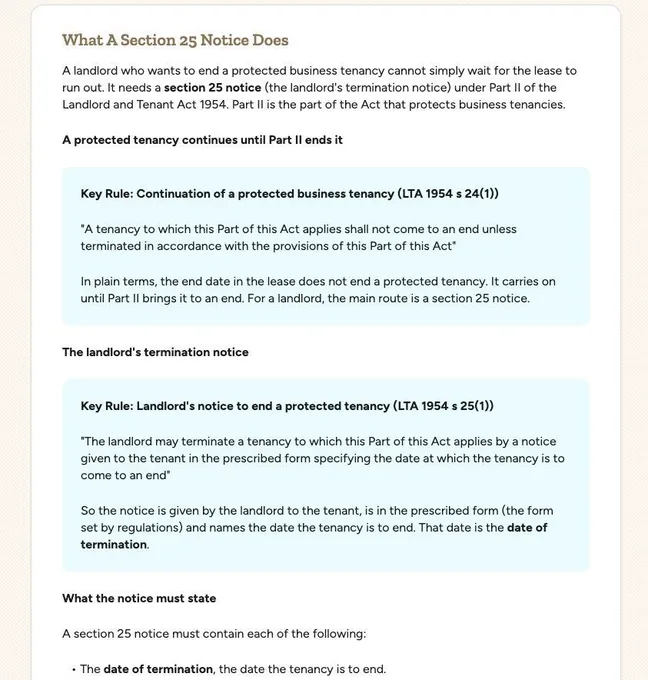
Full notes
Condensed: these are your revision notes. Perfect for when you’ve already covered a topic and just want to refresh your memory on the key rules and details, without having to go through everything again.
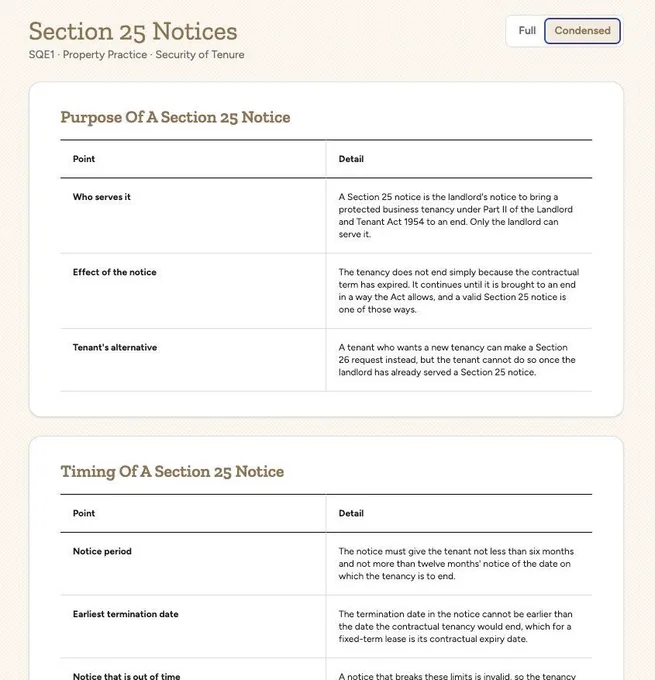
Condensed notes
And, of course, we’ve added more questions and flashcards.
We’ve added almost 400 more questions and also expanded our flashcard banks because you can never have too much practice.
We are constantly striving to make our material as good as possible and we cannot do that without you. So please, if you ever have any thoughts or suggestions as to how we can improve, then email dan@kinnu.xyz.
Quick note on SQE2
As mentioned last week, we’re currently developing our SQE2 product, and we’d love to give you a sneak peek at what we’ve been working on.
If you’re currently studying for SQE2, have already completed it, or know someone who might be interested in testing out some of our new materials, we’d love to hear from you.
Just hit reply and let us know.
Webinar reminder
Just a reminder that we are running an online webinar on Monday 16 November at 6pm to discuss all things SQE.
This is an opportunity for you to share your experiences and ideas with other SQE candidates, connect with fellow future lawyers and share ideas as to how we might be able to support you better.
RSVP
Co-no! (nership)
A father and his adult daughter purchase a registered house together as an investment property which they intend to let to tenants. The father pays the whole purchase price. The daughter is to be responsible for the day-to-day management of the property.
They are both registered as the legal proprietors. In the transfer deed, they expressly declare that they hold the beneficial interest as tenants in common in unequal shares: 90% for the father and 10% for the daughter. They also agree that net rental income will be divided in the same proportions.
The daughter dies in a car accident. By her will, she leaves her interest in the property to her husband.
The father seeks advice on the legal and beneficial ownership of the property following the daughter’s death.
Which of the following statements best describes the position?
- A. The husband becomes automatically registered as a legal proprietor in place of the daughter and holds the property with the father as legal joint tenants.
- B. Because the father paid the whole purchase price, he was always the sole legal and beneficial owner, and the daughter had no interest capable of passing to her husband.
- C. The father and daughter held both the legal estate and the beneficial estate as joint tenants, so the father now owns the entire legal and beneficial interest by survivorship.
- D. The father and daughter held the legal estate as tenants in common in shares of 90% and 10%, so the daughter’s 10% legal share passes to her husband under her will.
- E. The father and daughter held the legal estate as joint tenants and the beneficial estate as tenants in common; following the daughter’s death, the father is the sole legal owner, but the daughter’s 10% beneficial share passes under her will to her husband.
Show the answer
E. The father and daughter held the legal estate as joint tenants and the beneficial estate as tenants in common; following the daughter’s death, the father is the sole legal owner, but the daughter’s 10% beneficial share passes under her will to her husband.
Correct. Co-owned legal title cannot be held as a tenancy in common: under section 1(6) of the Law of Property Act 1925, the legal estate is held as a joint tenancy. On the daughter’s death, her legal title therefore passes to the father by survivorship. The beneficial interest is different. The express declaration in the transfer deed, supported by the investment nature of the arrangement and the agreed 90/10 split, means that the beneficial estate was held as a tenancy in common. The daughter’s 10% beneficial share is therefore capable of passing under her will to her husband.
Weil faces its own wind-down
Weil, Gotshal & Manges, the global law firm famous for advising on the Enron, General Motors and Lehman Brothers bankruptcies, is now facing its own collapse.
On 28 October, the firm’s management committee recommended an “orderly wind-down”, bringing a dramatic end to one of the most recognisable names in Big Law.
Why is this such a shock?
Weil isn’t a struggling small firm. It generated almost US$2.1 billion in revenue in 2025, employed around 1,200 lawyers and had offices across major financial centres, including New York, London, Munich and Hong Kong.
So how does a firm of this size unravel?
An exodus of partners. Over the summer, several high-profile partners left for competitors including Paul, Weiss, Simpson Thacher and Sullivan & Cromwell. In September, former corporate department chair Michael Aiello departed for Cravath, taking five partners with him.
Leadership uncertainty. Ramona Nee was due to take over from long-serving leader Barry Wolf in January 2027. However, she subsequently declined the position, leaving the firm’s future leadership unclear at a critical time.
Failed merger talks. Weil explored a potential merger with fellow US firm Willkie Farr & Gallagher, but discussions ultimately fell through, removing a possible lifeline.
What happens next?
Weil has brought in restructuring adviser AlixPartners to help manage its closure, which it intends to complete without entering bankruptcy proceedings.
The firm has said it will continue serving clients during the wind-down, although questions remain about the future of its lawyers, trainees and support staff.
Why should aspiring solicitors care?
There are some important commercial awareness lessons here:
Law firms are businesses, not just legal advisers. Their success depends heavily on retaining talented, revenue-generating partners. When those partners leave, clients and entire teams can follow, creating a domino effect that threatens the wider firm.
Prestige doesn’t guarantee stability. A firm’s reputation and revenue might look impressive, but they don’t tell the whole story. Partner departures, leadership uncertainty and failed mergers can all signal deeper problems.
Think carefully about where you train. This story is a reminder to research firms beyond their rankings and headline deals. Understanding their financial performance, strategy and culture can help you make a more informed decision about your career.
It’s a great commercial awareness example. If you’re asked about a recent legal news story in an interview, Weil’s collapse gives you plenty to discuss: competition for talent, partnership structures, law firm profitability and the pressures facing the global legal market.
The big takeaway? Even a prestigious, multibillion-dollar law firm isn’t immune to collapse. Weil’s story shows just how quickly things can unravel when key partners leave, leadership becomes uncertain and confidence in a firm’s future begins to disappear.
Sources:
Weil, Gotshal & Manges, longtime Wall Street law firm, plans wind down — CNBC, 28 October 2026
Law firm that handled Lehman, Enron bankruptcies plans to wind down — CNN, 28 October 2026
Weil set to dissolve as leadership recommends wind-down — Non-Billable, 28 October 2026
Weil faces shock closure as elite US law firm suffers dramatic fall — Legal Cheek, October 2026
Blurt it, then explain it to a client
Often, I found that just drilling MCQs wasn’t always the best way to consolidate my understanding of something. So, in addition to MCQs, once I’d finished a topic, I’d test myself in two steps.
Step 1: Blurt
Close your notes and write down everything you can remember about the topic: rules, cases, time limits, exceptions. Write it in any order, as fast as you can. Then open your notes and add what you missed in a different colour. The gaps show you exactly what you don’t know yet.
Step 2: Explain it to a client
Use what you’ve just recalled to write the topic out as if you were explaining it to a client who knows nothing about the law. Write in plain English, with no jargon: what the rule is, why it matters to them, and what they should do. For example, “If your brother dies without a will, here’s who gets what, and here’s why you might not inherit anything.”
Why the two steps work together
Blurting tests what you remember. It shows whether you can recall the law without your notes in front of you.
Explaining tests whether you understand it. If you can’t put a rule simply, you’ve memorised it without really getting it.
The second part is so important. I found that once I was able to distil a concept down into language which did not rely on overly verbose legalese, I had committed the concept to memory. Remember, for SQE1, it is the concepts and rules that matter far more than remembering specific statute or case law. So this approach really hammers down on that.